Binary, Hex and Data Units
The topic that costs more marks than any other on the paper, taught by hand. Bits and bytes, binary and hex in all six directions, the 1000-versus-1024 trap, file sizes, transmission times, overflow, two's complement and character sets. Every module ends in a timed drill marked the way an examiner marks it.
- trending_upBeginner
- schedule4h 11m
- menu_book9 leçons
- publicEnglish
- boltPool gratuit
Briefing
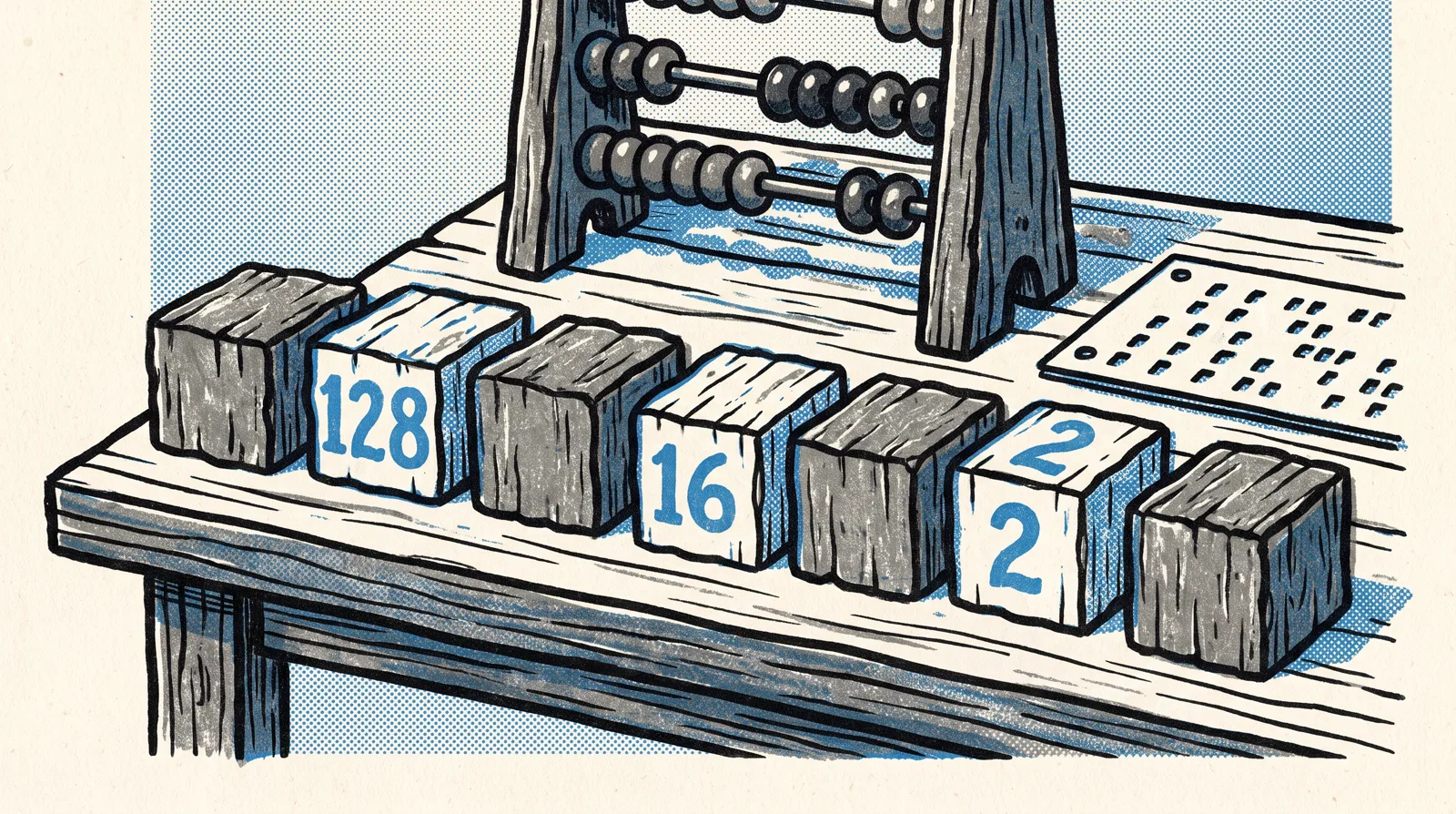
A student came to me with one week before her CAIE paper and could not convert KiB to MiB. She was not weak. She had been taught the topic three times and every time it was demonstrated on a calculator, which is no use at all in a room where you do not have one. This segment fixes that by making you write the same eight numbers down at the top of every single question — 128 64 32 16 8 4 2 1 — until you do it without deciding to. That is the whole method. It is slower than a trick for the first twenty minutes and faster than a trick for the rest of your life, and it does not fall apart when you are frightened. You will do binary to denary, denary to binary, binary to hex, hex to binary, denary to hex and hex to denary, all by hand. You will learn why a 1 TB drive shows up as 931 GB and which of those two numbers the examiner wants. You will calculate the size of an image and the time to send it. You will make a byte overflow, store a negative number in it, and look at the actual bits of the letter A. Every module ends with timed questions written in mark-scheme language — what earns the mark, and the answer that looks right and earns nothing. Written against the published topic lists for CAIE IGCSE 0478, UK GCSE Computer Science and IB CS SL. Every question is original and modelled on the shape of exam questions; no past paper or mark scheme is reproduced. Korra Academy is not affiliated with, or endorsed by, any exam board.
Plan du cours · 3 modules
lockSe déverrouille avec l'accès- 01 Bits, Bytes and Base Two3 leçons·1h 18m
You are not learning a trick today. You are learning a habit. Every conversion question in this segment starts by writing eight numbers across the top of your working, and you write them even when…
- 02 Hex, and the 1024 Trap3 leçons·1h 28m
Hex is not a new number system you have to learn. It is binary, grouped in fours, so that people can read it out loud. If you can convert four bits you can already do hex — you just do not know it…
- 03 Negatives, Overflow and Characters3 leçons·1h 25m
Everything so far assumed the number fits. This module removes that assumption. A byte is a fixed-size container, and the interesting behaviour starts at the moment you try to put something in it…
Questions fréquentes
- Qu'apprendrai-je dans Binary, Hex and Data Units ?
- The topic that costs more marks than any other on the paper, taught by hand. Bits and bytes, binary and hex in all six directions, the 1000-versus-1024 trap, file sizes, transmission times, overflow, two's complement and character sets. Every module ends in a timed drill marked the way an examiner m
- Ai-je besoin d'une expérience préalable ?
- Non — Binary, Hex and Data Units part des fondamentaux et convient aux débutants.
- Combien de temps dure Binary, Hex and Data Units ?
- Binary, Hex and Data Units comprend 3 modules et 9 leçons. Vous apprenez à votre propre rythme.
- Comment obtenir l'accès ?
- Binary, Hex and Data Units fait partie du pool gratuit — créez un compte gratuit et ajoutez-le à votre collection.
Plus dans Programmation