Networking, End to End
The subject nobody teaches as a subject, built from the address up for a defender. You do the arithmetic by hand, capture your own traffic, and read every line yourself. Analysis and defence only — no scanning, no malicious traffic, nothing you do not own.
- trending_upIntermediate
- schedule7h 46m
- menu_book12 lezioni
- publicEnglish
- workspace_premiumBasic
Briefing
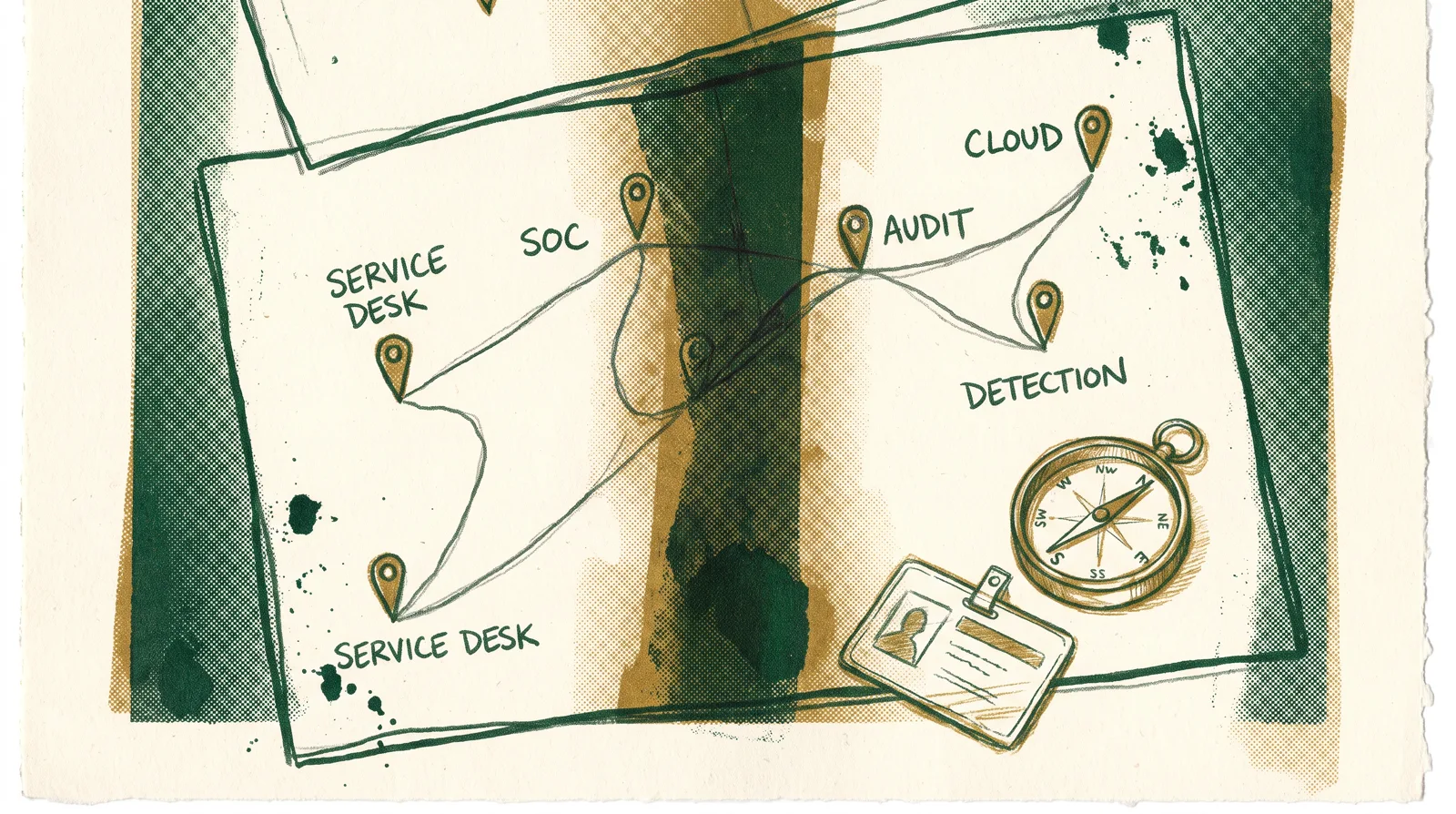
Every career-changer into security hits the same wall. The SOC segment assumes you can read an internal address and know why it matters. The lab segment makes you choose a network for a virtual machine in one lesson. The helpdesk segment teaches four commands to fix a user's connection. Nobody teaches the thing itself, from the address up, for somebody whose job is to read traffic and reason about it. So this segment is the thing itself, and it runs on one rule the whole way: you produce the numbers by hand, from your own machine, and every output shown is real. Every hexdump, every timing, every capture in these twelve lessons was produced on private addresses only and pasted in verbatim. When a lesson shows a connection taking twenty-one seconds, it is because a connection actually took twenty-one seconds and the number was measured. Module one is subnetting by hand — a mask is a boundary, the four numbers come out in a fixed order, and the size of a subnet is a security decision. Module two is the conversation: TCP against UDP with a packet capture of your own traffic open beside it, the three answers a connection attempt can get, and a DNS query you build and dump byte by byte. Module three is names and routes: the hostname legible in a real encrypted handshake, what an observer still sees after encryption, the routing table read as a list of rules, and one connection mapped end to end. Module four is boundaries: firewall rules and address translation read as rules rather than settings, segmentation as a control, and the address space that ran out while the hardware sat idle. Every lab carries the standing rules: permission first, respect scope, never production, always your own traffic. There is no scanning of anything you do not own and no malicious traffic anywhere. The one failure that would harm a real network to reproduce is a simulation by design.
Programma del corso · 4 moduli
lockSblocca con l'accesso- 01 Addresses, By Hand3 lezioni·1h 36m
Nothing in this module needs a tool until the last five minutes, when a script confirms the working you have already done in pen. The learner who reaches for a subnet calculator first has missed the…
- 02 The Conversation3 lezioni·1h 52m
Every timing and every hexdump in this module is real and was measured on the author's own machine. The capture lab is the learner's own traffic on the learner's own network, and the standing rules…
- 03 Names and Routes3 lezioni·1h 57m
This module holds the segment's one remaining load of real troubleshooting is elimination, not inspiration, spent in the end-to-end lab where seven stages are each determined one at a time. The…
- 04 Boundaries3 lezioni·2h 21m
The firewall and routing work is read-only: the learner reads a posture and reasons about it, never configures it. The capstone is a simulation by design because reproducing address exhaustion on a…
Domande frequenti
- Cosa imparerò in Networking, End to End?
- The subject nobody teaches as a subject, built from the address up for a defender. You do the arithmetic by hand, capture your own traffic, and read every line yourself. Analysis and defence only — no scanning, no malicious traffic, nothing you do not own.
- Ho bisogno di esperienza precedente?
- È consigliata una certa conoscenza precedente prima di iniziare Networking, End to End.
- Quanto tempo richiede Networking, End to End?
- Networking, End to End include 4 moduli e 12 lezioni. Impari al tuo ritmo.
- Come accedo?
- Networking, End to End è incluso in qualsiasi abbonamento a pagamento.
Altro in Cyber Defense