Programming for the Exam — Python Answers That Score
The programming half of the paper, taught at exam pitch. Pseudocode translated both ways, because the mark scheme is written in a notation nobody practises. Trace tables done column by column, including the ones with a loop and a condition inside it. Linear and binary search, bubble and insertion sort, what each costs and the comparison questions boards love. Validation against verification, and the boundary test data everybody forgets. Procedures against functions, and a systematic method for finding your own error with four minutes left.
- trending_upIntermediate
- schedule6h 38m
- menu_book12 lessons
- publicEnglish
- workspace_premiumBasic
Briffing
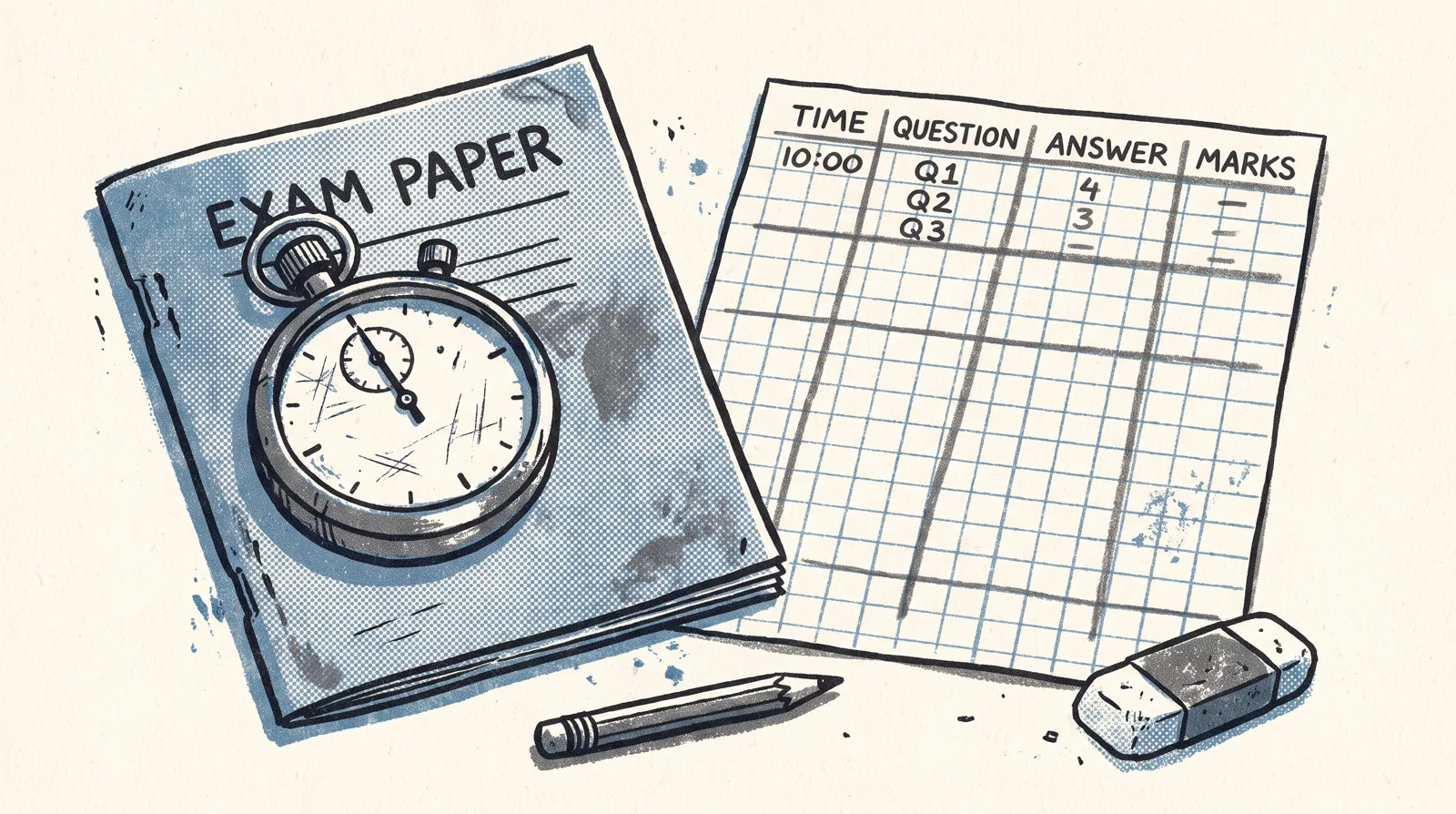
A learner sat down with me having written working Python for a year and having scored badly on every programming question he had ever attempted. Nothing was wrong with his code. The exam had never asked him for code. That is what this segment fixes. Exam boards mark pseudocode, not Python, and the notation is theirs — with ENDIF and ENDWHILE and an inclusive FOR i ← 1 TO 5 that means something quietly different from range(1, 5). Nobody practises the translation, everybody assumes their Python habits will carry, and the habits do not carry. So you will translate in both directions until it is dull. You will rule trace tables with an actual ruler and fill them a line at a time, including the rows where nothing changes — which is where the marks are and which is the first discipline to go under time pressure. You will trace a binary search on paper and count the comparisons, then answer the question boards keep asking: is it worth sorting a list of a thousand items so you can search it once? You will sort index cards with your hands before you write a sort in code. And you will learn to find a fault in your own program by halving it, systematically, rather than by reading it again harder — because a systematic method still works when you are frightened and reading harder does not. Every module ends with a timed drill marked the way an examiner marks it: what earns the mark, and the answer that looks right and earns nothing. Prerequisite: you can already write small Python programs — variables, if, loops, def, input(). This segment does not teach the language from zero. If it is still new, do Python From a White Sheet first; it is free and it is the exact sequence this one assumes. Written against the published topic lists for CAIE IGCSE 0478 and the UK GCSE Computer Science specifications, with notes for IB. The boards differ here more than anywhere — especially on pseudocode conventions, and on whether arrays are indexed from 0 or from 1 — and where they differ this segment names the difference and sends you to your own specification. Every question is original and modelled on the shape of exam questions; no past paper, mark scheme or specification text is reproduced, and Korra Academy is not affiliated with, or endorsed by, any exam board.
Amlinelliad y cwrs · 4 modules
lockYn datgloi gyda mynediad- 01 Their Notation, and Your Table3 lessons·1h 35m
The exam does not mark Python. Almost none of them do. You will sit a paper written in a notation that looks like BASIC assembled by a committee, and the mark scheme is written in it too. Two jobs,…
- 02 The Structures They Give Marks For3 lessons·1h 40m
Three separate IF statements are not an ELSE IF chain, and reversing the order of the conditions breaks it a second way. Both are one-line bugs, both are favourite exam questions, and both run…
- 03 The Standard Algorithms3 lessons·1h 40m
This module is done with your hands first. Numbered cards on a desk for the halving, a row of cards for the bubble pass, a hand of cards for the insertion. Every one of these algorithms was a…
- 04 Subprograms, Testing, and Your Own Errors3 lessons·1h 43m
Python has one keyword, def, and the exam has two things with two keywords. The whole distinction is one question: does a value come back to the place that called it? Learners who only write Python…
Cwestiynau a ofynnir yn aml
- Beth a ddysgaf yn Programming for the Exam — Python Answers That Score?
- The programming half of the paper, taught at exam pitch. Pseudocode translated both ways, because the mark scheme is written in a notation nobody practises. Trace tables done column by column, including the ones with a loop and a condition inside it. Linear and binary search, bubble and insertion so
- A oes angen profiad blaenorol arnaf?
- Argymhellir rhywfaint o wybodaeth flaenorol cyn dechrau Programming for the Exam — Python Answers That Score.
- Pa mor hir y mae Programming for the Exam — Python Answers That Score yn ei gymryd?
- Mae Programming for the Exam — Python Answers That Score yn cynnwys 4 modules ac 12 lessons. Rydych chi'n dysgu ar eich pace eich hun.
- Sut rydw i'n cael mynediad?
- Mae Programming for the Exam — Python Answers That Score yn cael ei gynnwys gydag unrhyw danysgrifiad talu.
Mwy yn Rhaglennu